Announcements
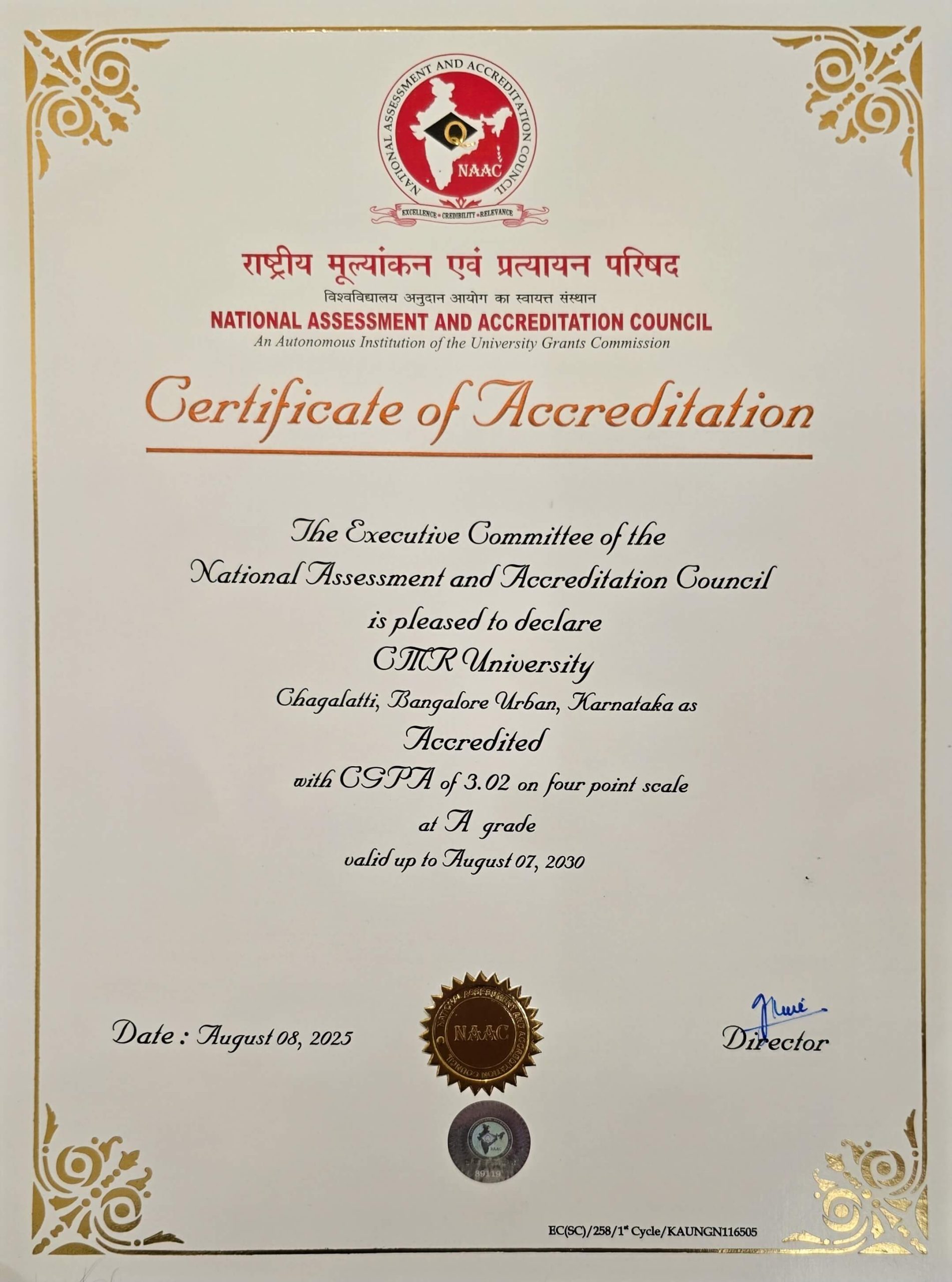
CMR University is proud to have received an ‘A’ grade accreditation from the National Assessment and Accreditation Council (NAAC)
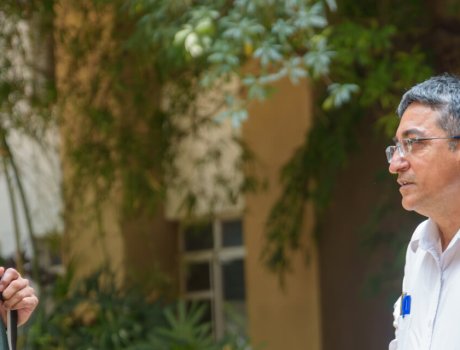
CMR University proudly welcomes Padma Shri Dr. Prahalada Ramarao, renowned DRDO & ISRO scientist, as Professor Emeritus.
You may walk into any campus of CMRU for enquiry and admission to any program offered by CMRU in any of its campuses
CMR University’s School of Engineering and Technology has secured Third rank in India in the Emerging Institutes category and Placement category at the Times All India Engineering Institutes Ranking Survey 2024.
CMR University’s School of Engineering and Technology has secured Second rank in the Emerging Engineering Institutes Research Capability category at the Times All India Engineering Institutes Ranking Survey 2024.
We honour JEE, Comed-K and all National-level tests
Applications are invited for the position of "Field Assistant" to work with CMRIT for the DST-SERB project.
School of Legal Studies is ranked 7th among India’s Top Law Colleges 2023 – Private Colleges by Outlook Magazine
Join our dynamic Team today! We're Hiring!
1532 Degrees, 34 Gold Medalists & 27 PhD's Conferred at CMRU 8th Annual Convocation
CMR University is deservedly accoladed with 9th rank among the best private Universities in Karnataka by IIRF.
Among the top technical Universities in Karnataka, CMR University ranks 7th - IIRF.
IIRF recognizes CMR University as the 7th best University for Arts, Science, Research and Humanities in South Zone and in Karnataka.
CMR University ranked 23rd Best University across India by IIRF.
CMR University, School of Legal Studies prefers LSAT—India™ scores as part of the selection process for admission to all our programmes.
CMR University receives Emerging University of the year by ASSOCHAM National Council at the 15th International Education Leadership & Skill Development Summit" in New Delhi
First Alumni Association Board at CMR University formed
CMR University Bengaluru rated amongst "Perfect Workplaces For Women in 2022" by Artificial Intelligence Registration and Certification, U.K.
CMR University Bengaluru receives "5-star ratings" by Artificial Intelligence Registration and Certification, U.K., and is now one of the "Best Places to Work" in 2022.
CMR University Bengaluru secures 40th position, in the 2021 Global Impact Rankings by R World Institutional Ranking, for contributing towards Sustainable Development Goals of the Earth.
On-line learning – ICT initiatives of MHRD and UGC
CMR University, in collaboration with the Institute of Product Leadership, launches an MBA in Technology Management.
2188 Degrees, 34 Gold Medalists and 24 PhD Awardees Honored at CMR University’s 9th Annual Convocation
Last date for Ph.D. applications extended!